
Last Added
1,829 photos · newest first
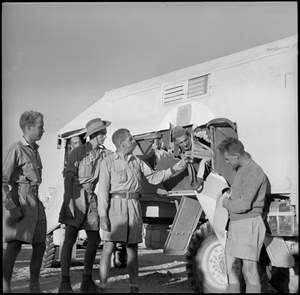
Ambulance damaged by a shell the during breakout at Minqar Qaim, June 1942. Photograph taken by Harold Paton, an official photographer of the 2nd New Zealand Expeditionary Force Shell hole in side of American Field Service ambulance in withdrawal from Minqar Qaim, Egypt - Photograph taken by H Paton. New Zealand. Department of Internal Affairs. War History Branch :Photographs relating to World War 1914-1918, World War 1939-1945, occupation of Japan, Korean War, and Malayan Emergency. Ref: DA-02550-F. Alexander Turnbull Library, Wellington, New Zealand.
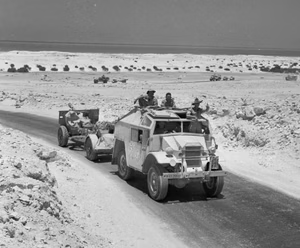
A CMP Field Artillery Tractor of the 9th Australian Division pulls a 25 pounder field gun up into position during the First Battle of El Alamein, 9 July 1942
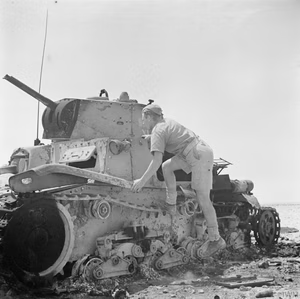
The British Army in North Africa 1942 A soldier inspects an Italian M13/40 tank that was knocked out by anti-tank guns near El Alamein, 11 July 1942.
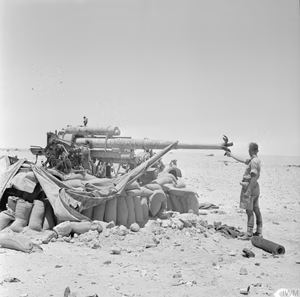
The British Army in North Africa 1942 A German 88mm anti-tank gun captured and destroyed by New Zealand troops near El Alamein, 17 July 1942.
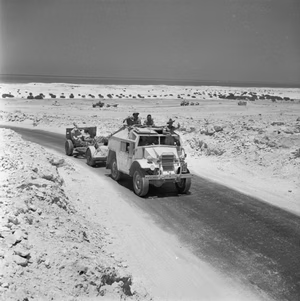
The British Army in North Africa 1942 A Quad artillery tractor and 25-pdr field gun of 9th Australian Division, 9 July 1942.
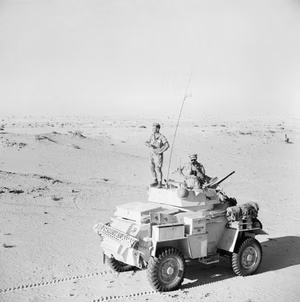
A Humber Mk II armoured car of the 12th Royal Lancers on patrol south of El Alamein, July 1942. A Humber Mk II armoured car of the 12th Royal Lancers on patrol south of El Alamein, July 1942.
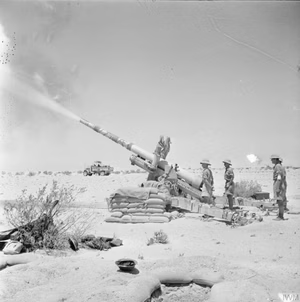
The British Army in North Africa 1942 A 4.5-inch field gun in action south of El Alamein, July 1942.
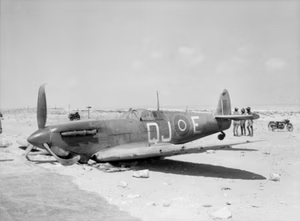
A Supermarine Spitfire Mk.Vb from No. 92 Squadron (QJ-E), Royal Air Force, which made a forced landing near El Alamein, just off the main Alexandria-Mersa Matruh road.
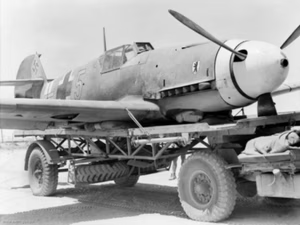
Western Desert, Egypt, 14 August 1942: A captured German Messerschmitt Me 109F ("yellow 5") of 6/JG27 (6th Squadron, 27th Fighter Wing) piloted by Lieutenant Gert Mix which made a forced landing in the rear of the Australian lines near El Alamein is loaded on to a transport to be taken to RAF workashops for examination by experts. Other German planes had tried to destroy this plane after landing in order to prevent expert examination.
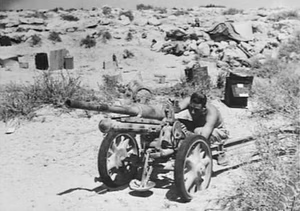
A German "47.32 millimetre choke-bore anti-tank gun" being inspected by regimental Sergeant-Major P. Lawson, of 2/32nd Australian Infantry Battalion near El Alamein in 1942.
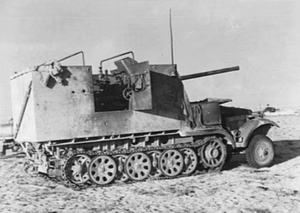
A damaged German SdKfz 6/3 (7,62 cm captured Russian F-22 gun 296(r) mounted on a SdKfz 6 half track) of the 605th Panzerjäger-Abteilung near El Alamein, Egypt, in August 1942.
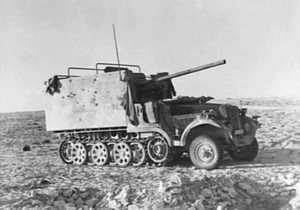
A damaged German SdKfz 6/3 (7,62 cm captured Russian F-22 gun 296(r) mounted on a SdKfz 6 half track) of the 605th Panzerjäger-Abteilung near El Alamein, Egypt, in August 1942.
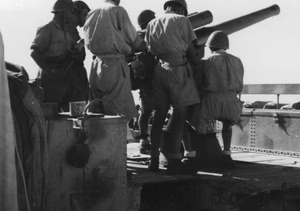
Italian anti-aircraft battery at Marsa Matrouh in the summer of 1942
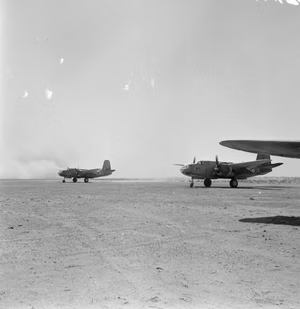
Royal Air Force- Operations in the Middle East and North Africa, 1939-1943. Douglas Boston Mark IIIs of No. 24 Squadron SAAF prepare to take off from Bir el Beheira, Libya, to bomb enemy positions in the 'Knightsbridge' area during the first Battle of Alamein.
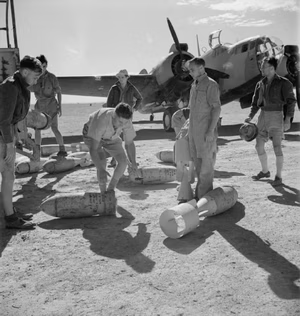
Royal Air Force- Operations in the Middle East and North Africa, 1940-1943. Armourers fitting tail fins to 250-lb GP bombs prior to loading them on board a Martin Baltimore of No. 232 Wing RAF at LG 86, Egypt, during Operation LIGHTFOOT, the first phase of the Alamein offensive.
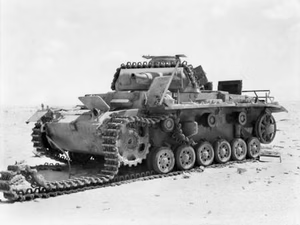
A knocked out German Panzer III in the Western Desert.
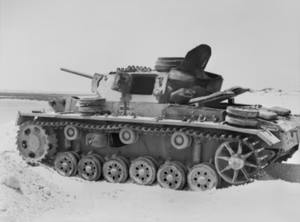
A German Panzer III Ausf.L that was knocked out by Australian anti-tank gunners at El Alamein in August 1942. A small hole slightly above and between the 2nd and 3rd wheels from the right was where the effective shell entered.
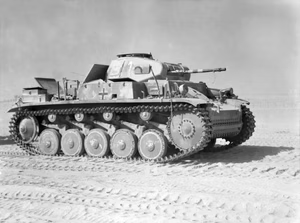
A captured German Panzerkampfwagen II near El Alamein, Egypt, 1 August 1942.
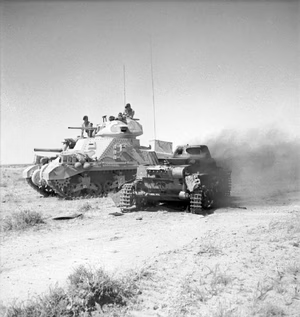
A British M3 Grant tank next to a knocked out a German Panzerkampfwagen I light tank on 6 June 1942 in North Africa.
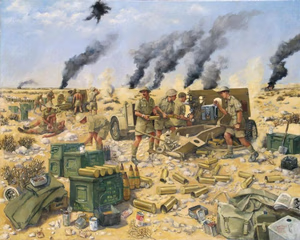
Guns of the 11th Field Regiment in Action With Robcol, Ruweisat Ridge, El Alamein July 1942 image: British field artillery firing on German tanks in the desert. In the distance there are columns of smoke filling the sky. On the left one man is attending to a wounded soldier who lies on the ground. The foreground is filled with bags, shell cases, food containers and rations scattered across the sand.
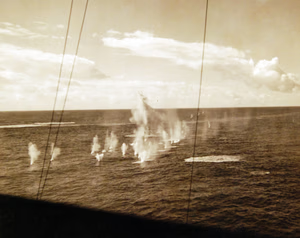
80-G-30302: Operation Torch, November 1942. A U.S. warship lays down a barrage of high explosive shells. The ship, en-route to North Africa, fired after an enemy submarine was reported in the vicinity. Official U.S. Navy Photograph, now in the collections of the National Archives. (2017/06/06).
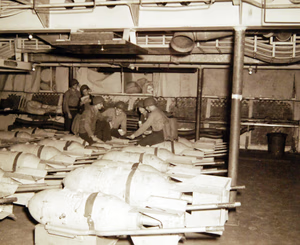
80-G-30263: Operation Torch, November 1942. USS Ranger (CV-4), bombs onboard during the Amphibious Force invasion. Bluejackets are guarding bombs. Standing left to right: Seaman First Class J.B. Williams; Aviation Machinist’s Mate Third Class M.S. Beaker. Seated. Seaman First Class J.A. Bagnera; Aviation Machinist’s Mate M. H. Angrist; Seaman Second Class E.M. Dembrowski; and Seaman Second Class D.G. Dinges. Official U.S. Navy Photograph, now in the collections of the National Archives. (2017/06/06).
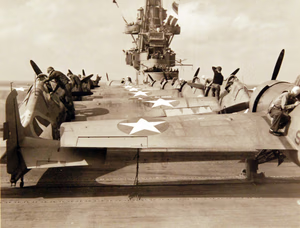
80-G-30281: Operation Torch, November 1942. Planes of USS Ranger (CV-4) en-route to invade French North Africa. Plane captains check over fighters, preparatory to taking off on another raid while the pilots are below being briefed by intelligence officers. Official U.S. Navy Photograph, now in the collections of the National Archives. (2017/06/06).
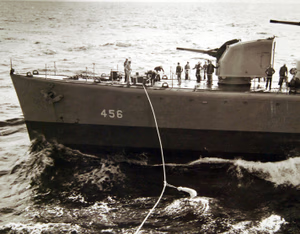
80-G-30255: Operation Torch, November 1942. USS Rodman (DD-456) Official U.S. Navy Photograph, now in the collections of the National Archives. (2017/06/06).