Tracefront

Last Added

1,829 photos · newest first
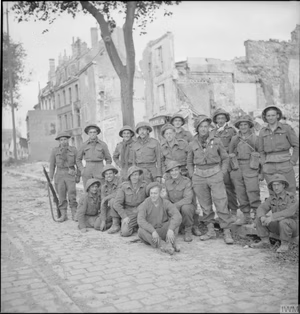
The British Army in the Normandy Campaign 1944 Men of 1st King's Own Scottish Borderers, 3rd Division, some of the first troops to enter Caen after Operation 'Charnwood', 9 July 1944.
The British Army in the Normandy Campaign 1944 Men of 1st King's Own Scottish Borderers, 3rd Division, some of the first troops to enter Caen after Operation 'Charnwood', 9 July 1944.

Caen13 Jun 2026
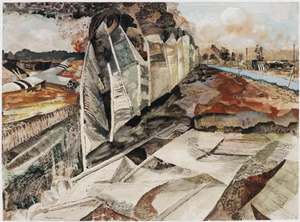
France- the Beach Head, 1944; the road between St Aubin and Benouville, the main supply route to the troops on the east side of the River Orne. It was under constant shell fire from the German batteries around Caen. image: a landscape showing a road under artillery bombardment. A line of protective camouflaged screens lie in the centre of the image, the screens in the foreground having been damaged. Two damaged Horsa gliders lie on the ground, one on the right next to the road, and the other on the left, its wings still intact. Plumes of black smoke, the result of the bombardment, emerge from behind the line of screens.
France- the Beach Head, 1944; the road between St Aubin and Benouville, the main supply route to the troops on the east side of the River Orne. It was under constant shell fire from the German batteries around Caen. image: a landscape showing a road under artillery bombardment. A line of protective camouflaged screens lie in the centre of the image, the screens in the foreground having been damaged. Two damaged Horsa gliders lie on the ground, one on the right next to the road, and the other on the left, its wings still intact. Plumes of black smoke, the result of the bombardment, emerge from behind the line of screens.

Caen13 Jun 2026
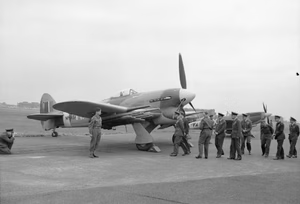
Royal Air Force- 2nd Tactical Air Force, 1943-1945. King George VI and his entourage of senior RAF officers walk over to Hawker Typhoon Mark IB, MN454 'HF-S', of No. 183 Squadron RAF, while inspecting aircraft and equipment which will be used in the forthcoming invasion of Normandy at Northolt, Middlesex. MN454 was flown by the Commanding Officer of 183 Squadron, Squadron Leader the Hon. F H Scarlett. Behind the King's party is a Supermarine Spitfire Mark IX of No. 222 Squadron RAF.
Royal Air Force- 2nd Tactical Air Force, 1943-1945. King George VI and his entourage of senior RAF officers walk over to Hawker Typhoon Mark IB, MN454 'HF-S', of No. 183 Squadron RAF, while inspecting aircraft and equipment which will be used in the forthcoming invasion of Normandy at Northolt, Middlesex. MN454 was flown by the Commanding Officer of 183 Squadron, Squadron Leader the Hon. F H Scarlett. Behind the King's party is a Supermarine Spitfire Mark IX of No. 222 Squadron RAF.

Caen13 Jun 2026
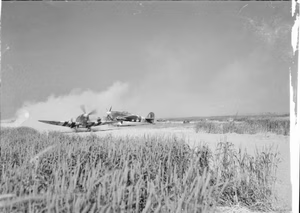
Royal Air Force- 2nd Tactical Air Force, 1943-1945. A Supermarine Spitfire Mark IX raises the dust as it taxies past a Hawker Typhoon Mark IB of No. 181 Squadron RAF, at an advanced landing ground - probably B2/Bazenville - in Normandy. The Spitfire is fitted with a 45-gallon 'slipper' fuel tank.
Royal Air Force- 2nd Tactical Air Force, 1943-1945. A Supermarine Spitfire Mark IX raises the dust as it taxies past a Hawker Typhoon Mark IB of No. 181 Squadron RAF, at an advanced landing ground - probably B2/Bazenville - in Normandy. The Spitfire is fitted with a 45-gallon 'slipper' fuel tank.

Caen13 Jun 2026
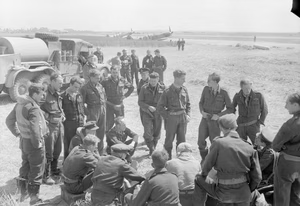
Royal Air Force- 2nd Tactical Air Force, 1943-1945. Hawker Typhoon pilots of Nos. 121 and 124 Wings discuss operations at B2/Bazenville, Normandy, on the evening of 14 June 1944. In the foreground, standing on the left, are five pilots of No. 175 Squadron RAF, including the Commanding Officer, Squadron Leader M R Ingle-Finch (fourth from left): on the right stand members of No. 181 Squadron RAF with their commander, Squadron Leader C D 'Kit' North-Lewis sitting on the far right. In the farthest group, those identified include Wing Commander C L Green (wearing helmet) leader of No. 121 Wing, and Squadron Leader W Pitt-Brown, commander of No. 174 Squadron RAF (on the right, wearing a lanyard). In the background, Supermarine Spitfire Mark IXs of No. 66 Squadron RAF stand at their dispersal points.
Royal Air Force- 2nd Tactical Air Force, 1943-1945. Hawker Typhoon pilots of Nos. 121 and 124 Wings discuss operations at B2/Bazenville, Normandy, on the evening of 14 June 1944. In the foreground, standing on the left, are five pilots of No. 175 Squadron RAF, including the Commanding Officer, Squadron Leader M R Ingle-Finch (fourth from left): on the right stand members of No. 181 Squadron RAF with their commander, Squadron Leader C D 'Kit' North-Lewis sitting on the far right. In the farthest group, those identified include Wing Commander C L Green (wearing helmet) leader of No. 121 Wing, and Squadron Leader W Pitt-Brown, commander of No. 174 Squadron RAF (on the right, wearing a lanyard). In the background, Supermarine Spitfire Mark IXs of No. 66 Squadron RAF stand at their dispersal points.

Caen13 Jun 2026
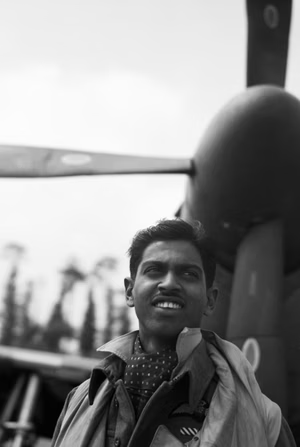
Flight Lieutenant C L F "Jimmy" Talalla of No. 122 Squadron RAF, standing in front of his North American Mustang Mk III at Ellon, Normandy, 6 August 1944. Flight Lieutenant C L F "Jimmy" Talalla of No. 122 Squadron RAF, standing in front of his North American Mustang Mark III at B12/ Ellon, Normandy. Born of Singhalese parents in Kuala Lumpur, Malaya, Talalla joined the RAF in 1941 and served as a sergeant pilot with No. 118 Squadron RAF, flying Supermarine Spitfires, before being commissioned in 1942. He joined 122 Squadron as a flight commander in 1944 and finished the war having shot down 5 enemy aircraft. His brother, Warrant Officer H C B Talalla, a Hawker Typhoon pilot serving with No. 182 Squadron RAF, was killed in action, over the Falaise area on 25 July 1944.
Flight Lieutenant C L F "Jimmy" Talalla of No. 122 Squadron RAF, standing in front of his North American Mustang Mk III at Ellon, Normandy, 6 August 1944. Flight Lieutenant C L F "Jimmy" Talalla of No. 122 Squadron RAF, standing in front of his North American Mustang Mark III at B12/ Ellon, Normandy. Born of Singhalese parents in Kuala Lumpur, Malaya, Talalla joined the RAF in 1941 and served as a sergeant pilot with No. 118 Squadron RAF, flying Supermarine Spitfires, before being commissioned in 1942. He joined 122 Squadron as a flight commander in 1944 and finished the war having shot down 5 enemy aircraft. His brother, Warrant Officer H C B Talalla, a Hawker Typhoon pilot serving with No. 182 Squadron RAF, was killed in action, over the Falaise area on 25 July 1944.

Caen13 Jun 2026
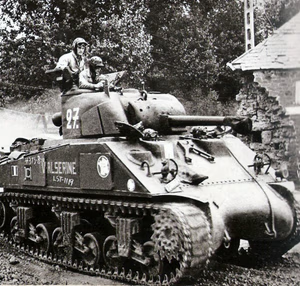
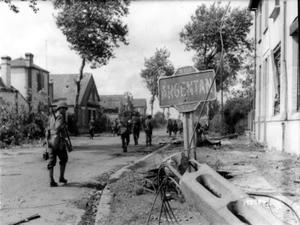
Carro M4 Sherman della 2e division blindée francese in avanzata verso Argentan durante la battaglia di Normandia
Carro M4 Sherman della 2e division blindée francese in avanzata verso Argentan durante la battaglia di Normandia

Falaise Pocket13 Jun 2026
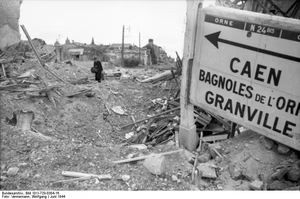
Frankreich, bei Falaise.- zerstörte Gebäude in Ortschaft. Wegweiser "Caen, Bagnoles de l'Orne, Granville". Alte Frau zwischen den Trümmern, Mitte Juni 1944; KBZ Ob. West — Frankreich
Frankreich, bei Falaise.- zerstörte Gebäude in Ortschaft. Wegweiser "Caen, Bagnoles de l'Orne, Granville". Alte Frau zwischen den Trümmern, Mitte Juni 1944; KBZ Ob. West — Frankreich

Falaise Pocket13 Jun 2026
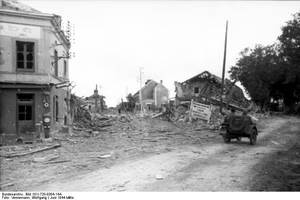
Frankreich, bei Falaise.- zerstörte Gebäude in Ortschaft. Krad mit Beiwagen Wegweiser "Caen, Bagnoles de l'Orne, Granville" passierend; KBZ Ob. West — Frankreich
Frankreich, bei Falaise.- zerstörte Gebäude in Ortschaft. Krad mit Beiwagen Wegweiser "Caen, Bagnoles de l'Orne, Granville" passierend; KBZ Ob. West — Frankreich

Falaise Pocket13 Jun 2026
Soldats américains dans Argentan libérée
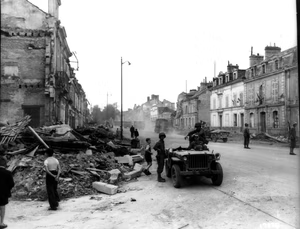
Soldats américains dans Argentan libérée

Falaise Pocket13 Jun 2026
Soldats américains dans Alençon en août 1944
Soldats américains dans Alençon en août 1944

Falaise Pocket13 Jun 2026
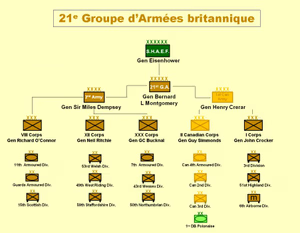
Organisation et composition de l'armée britannique. Organisation et composition de l'armée britannique.
Organisation et composition de l'armée britannique. Organisation et composition de l'armée britannique.

Falaise Pocket13 Jun 2026
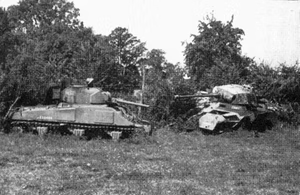
Destroyed tanks on Mont Ormel (Hill 262). Left is a Sherman, right foreground is an SdKfz 251, behind it is a Panther
Destroyed tanks on Mont Ormel (Hill 262). Left is a Sherman, right foreground is an SdKfz 251, behind it is a Panther

Falaise Pocket13 Jun 2026
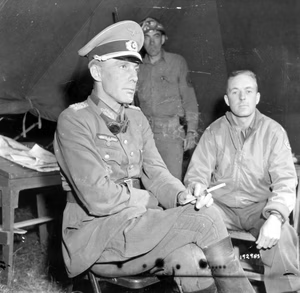
Lt. General Ellfeldt was captured while trying to pull out of the Allies' pincer movement. Questioning him is Lt. Col. James J. Gaynor, G-2, 5th Corps. Actual capture took place at St. Lambert-Sur-Dives, France. 21 August, 1944. Photographer: Poinsett.
Lt. General Ellfeldt was captured while trying to pull out of the Allies' pincer movement. Questioning him is Lt. Col. James J. Gaynor, G-2, 5th Corps. Actual capture took place at St. Lambert-Sur-Dives, France. 21 August, 1944. Photographer: Poinsett.

Falaise Pocket13 Jun 2026
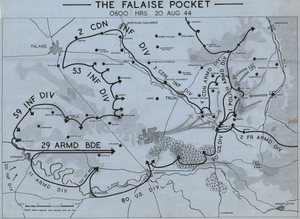
Map showing Allied encirclement operations around the Falaise Pocket at 0600 hrs on 20 August 1944.
Map showing Allied encirclement operations around the Falaise Pocket at 0600 hrs on 20 August 1944.

Falaise Pocket13 Jun 2026
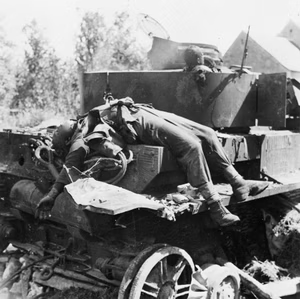
The British Army in Normandy 1944 A knocked-out German PzKpfw IV tank with the burnt bodies of two of its crew in the Falaise pocket, 24 August 1944.
The British Army in Normandy 1944 A knocked-out German PzKpfw IV tank with the burnt bodies of two of its crew in the Falaise pocket, 24 August 1944.

Falaise Pocket13 Jun 2026
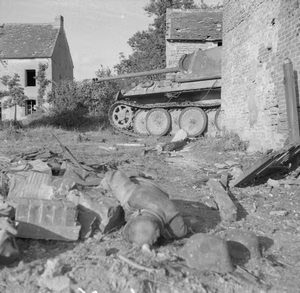
The British Army in Normandy 1944 A knocked-out German Panther tank and a dead infantryman in the Falaise pocket, 25 August 1944.
The British Army in Normandy 1944 A knocked-out German Panther tank and a dead infantryman in the Falaise pocket, 25 August 1944.

Falaise Pocket13 Jun 2026
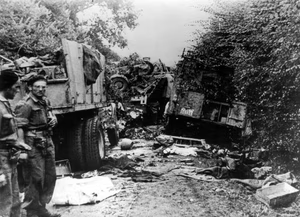
German column destroyed by 1st Polish Armoured Division in Normandy 1944.
German column destroyed by 1st Polish Armoured Division in Normandy 1944.

Falaise Pocket13 Jun 2026
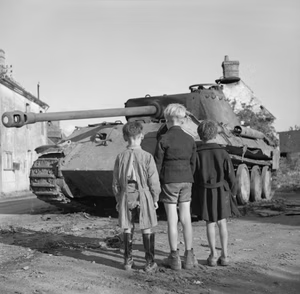
Three French boys looking at a knocked-out German Panther tank in the Falaise pocket, Normandy, 25 August 1944. Three French boys looking at a knocked-out German Panther tank in the Falaise pocket, 25 August 1944.
Three French boys looking at a knocked-out German Panther tank in the Falaise pocket, Normandy, 25 August 1944. Three French boys looking at a knocked-out German Panther tank in the Falaise pocket, 25 August 1944.

Falaise Pocket13 Jun 2026
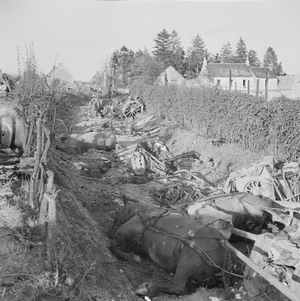
The Allied Campaign in North-west Europe, 6 June 1944 - 7 May 1945 The Falaise Gap: Dead German horses among devastated vehicles and equipment in a lane in the Falaise pocket; this was a typical scene after the battle.
The Allied Campaign in North-west Europe, 6 June 1944 - 7 May 1945 The Falaise Gap: Dead German horses among devastated vehicles and equipment in a lane in the Falaise pocket; this was a typical scene after the battle.

Falaise Pocket13 Jun 2026
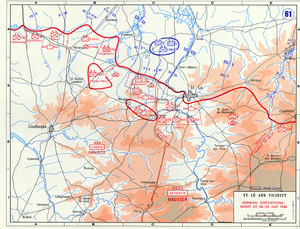
Saint Lo and Vicinity

Saint Lo and Vicinity

Operation Cobra / Saint-Lô13 Jun 2026
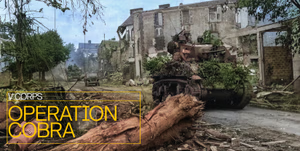
U.S. tanks pass through the wrecked streets of Coutances, France. This illustration was created using Adobe Photoshop, with added yellow box and text to highlight the significance of Operation Cobra and V Corps' contributions, and the photo was colorized using Photoshop restoration tools. (U.S. Army illustration by Tyler Brock)
U.S. tanks pass through the wrecked streets of Coutances, France. This illustration was created using Adobe Photoshop, with added yellow box and text to highlight the significance of Operation Cobra and V Corps' contributions, and the photo was colorized using Photoshop restoration tools. (U.S. Army illustration by Tyler Brock)

Operation Cobra / Saint-Lô13 Jun 2026
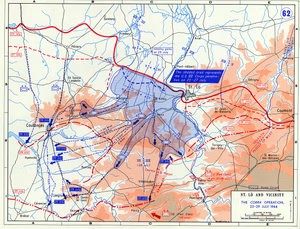
Saint Lo and Vicinity - Operation Cobra - 25-29 July 1944. Background information: In 1938 the predecessors of what is today The Department of History at the United States Military Academy began developing a series of campaign atlases to aid in teaching cadets a course entitled, "History of the Military Art." Since then, the Department has produced over six atlases and more than one thousand maps, encompassing not only America’s wars but global conflicts as well. In keeping abreast with today's technology, the Department of History is providing these maps on the internet as part of the department's outreach program. The maps were created by the United States Military Academy’s Department of History and are the digital versions from the atlases printed by the United States Defense Printing Agency. We gratefully acknowledge the accomplishments of the department's former cartographer, Mr. Edward J. Krasnoborski, along with the works of our present cartographer, Mr. Frank Martini.

Saint Lo and Vicinity - Operation Cobra - 25-29 July 1944. Background information: In 1938 the predecessors of what is today The Department of History at the United States Military Academy began developing a series of campaign atlases to aid in teaching cadets a course entitled, "History of the Military Art." Since then, the Department has produced over six atlases and more than one thousand maps, encompassing not only America’s wars but global conflicts as well. In keeping abreast with today's technology, the Department of History is providing these maps on the internet as part of the department's outreach program. The maps were created by the United States Military Academy’s Department of History and are the digital versions from the atlases printed by the United States Defense Printing Agency. We gratefully acknowledge the accomplishments of the department's former cartographer, Mr. Edward J. Krasnoborski, along with the works of our present cartographer, Mr. Frank Martini.

Operation Cobra / Saint-Lô13 Jun 2026
Organization of VII, VIII, and XIX U.S. Army Corps during Operation Cobra 25 July 1944

Organization of VII, VIII, and XIX U.S. Army Corps during Operation Cobra 25 July 1944

Operation Cobra / Saint-Lô13 Jun 2026