
Last Added
1,829 photos · newest first
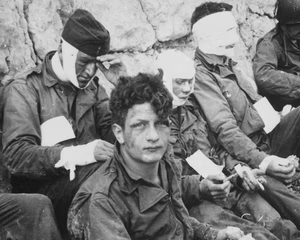
General notes: Use War and Conflict Number 1043 when ordering a reproduction or requesting information about this image.
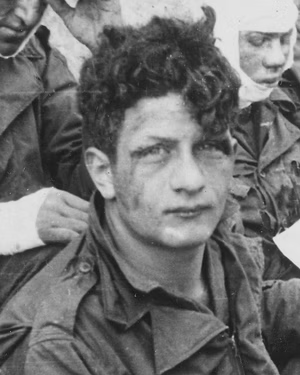
General notes: Use War and Conflict Number 1043 when ordering a reproduction or requesting information about this image.
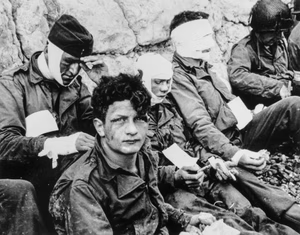
American Assault Troops of the 16th Infantry Regiment, Injured While Storming Omaha Beach, Wait by the Chalk Cliffs for Evacuation to a Field Hospital for Further Medical Treatment, Collville sur Mer, Normandy, France NARA 531187
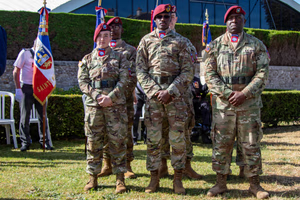
U.S. paratroopers assigned to the 82nd Airborne Division chorus prepare to celebrate the Three Cemeteries Monument during the 82nd commemoration of D-Day at Sainte Mere Eglise, France, June 2, 2026. The Three Cemeteries Monument honors the 14,000 U.S. troops, particularly from the 82nd Airborne Division, who fell during the battle to liberate Normandy, France. On June 6, 1944, the United States military participated in the largest multinational amphibious landing and operational military airdrop in history. This assault led to France’s liberation from the German military and the eventual defeat of the Nazis. By the end of the D-Day invasion, more than 9,000 allied troops were dead or wounded. (U.S. Army photo by Maj. Joe Legros)
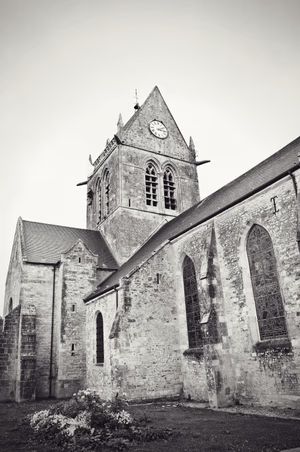
The Sainte-Mère-Église church in Normandy was built in the 11th century in the Romanesque style and completed four centuries later in the Gothic style. It’s topped by a saddleback bell tower and gained a place in history on D-Day as one of the first towns to be liberated. This was achieved through the efforts of American paratroopers who were dropped into Sainte-Mère-Église in the early hours of 6th June 1944. Photo from the site of Airborne Museum , a French museum dedicated to the memory of paratroopers of the 82nd and 101st Airborne Divisions of the United States Army who parachuted into Normandy on the night of June 5–6, 1944. Sainte-Mère-Église, Arrondissement de Cherbourg, Normandy. Summer holidays in France, August 2019
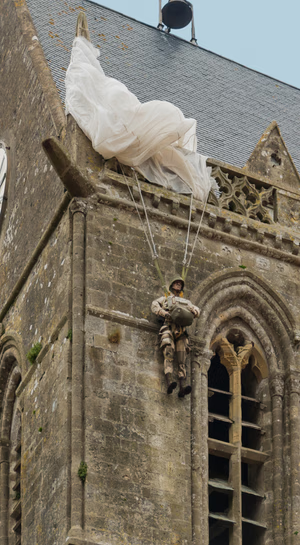
US Paratrooper, representing John Steele (paratrooper) , 82nd Airborne, june 6th, 1944, bell tower of church of Sainte-Mère-Église, Manche, Normandy, France.
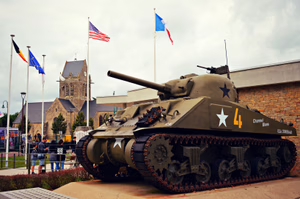
This M4A1(76)W HVSS Sherman Tank (sometimes called the M4A1E8 Easy 8) is part of the WW2 D-Day landings display at the US Airborne Forces Museum in Saint-Mere-Eglise. The Museum is built on the site of the house that was bombed and burnt down on D-Day that is seen on the film the Longest Day. It was the light from this fire that enabled the Germans stationed in the town to shot so many paratroopers as they were blown off course and landed in Saint-Mere-Eglise. The problem is that this version of the Sherman tank never took part in the D-Day landings on 6th June 1944 or the battle for Normandy. The first 'Easy Eight' M4A1(76)W HVSS Sherman tanks only arrived in Europe in December 1944. Photo of misc. World War II militaria in Airborne Museum , a French museum dedicated to the memory of paratroopers of the 82nd and 101st Airborne Divisions of the United States Army who parachuted into Normandy on the night of June 5–6, 1944. Sainte-Mère-Église, Arrondissement de Cherbourg, Normandy. Summer holidays in France, August 2019
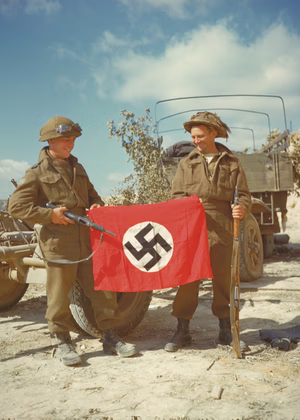
Ces deux soldats canadiens arborent un drapeau nazi qu'ils ont capturé dans les galeries de la carrière des Aucrais à Haut-Mesnil. Le fanion nazi ne semble pas avoir beaucoup servi et était vraisemblablement plié dans la sacoche de l'attelage, celle qui gît à leurs pieds sur la droite de la photo. Derrière les deux soldats, ce qui ressemble à une remorque "polyvalente" allemande Sd Anh 104, voir ici : www.lonesentry.com/ordnance/sd-anh-203-special-trailer.html Voir le camouflage fait de branches accrochées sur les côtés du camion. Le soldat de gauche est muni d'une Sten MkII fr.wikipedia.org/wiki/Sten_Mk_II et celui de droite d'un fusil Lee-Enfield n°4 MkI fr.wikipedia.org/wiki/Lee_Enfield_n%C2%B04 Photo prise le 10 Août 1944. A gauche le Pte. L.B. Roy, Cornwall, Ontario du The Queen's Own Cameron Highlanders of Canada de la 6th Infantry Brigade de la 2nd Cdn ID, il porte sur son casque une paire de lunettes de motocycliste allemand, voir ici: www.flickr.com/photos/mlq/8500700876/in/photostream Voir ici, avec un autre camarade au même endroit : www.flickr.com/photos/mlq/2547930365/in/pool-autresphotos... www.flickr.com/photos/mlq/2547930361/ Ce hameau a été libéré le 8 août, dans le cadre de " Operation Totalize " par The Argyll and Sutherland Highlanders of Canada-Princess Louise's de la 10th Inf. Brigade de la 4th Canadian Armoured Div. Dans les galeries de la carrière des Aucrais, les Allemands ont stocké du matériel, et une maquette de V2 à l'échelle 1 avec un chariot de transport du missile. Le 14 août, une erreur d'interprétation de signaux de fumée, fait que les bombardiers lourds du Bomber Command larguent leurs bombes sur les Canadiens et les Polonais à Haut-Mesnil faisant 400 victimes dont 65 morts. Pour aller plus loin : fr.wikipedia.org/wiki/Op%C3%A9ration_Totalize www.etab.ac-caen.fr/discip/geologie/mesozoi/bathoni/calca...
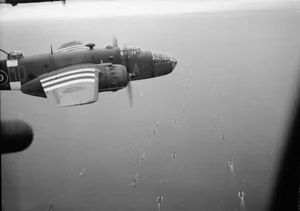
Royal Air Force- 2nd Tactical Air Force, 1943-1945. North American Mitchell Mk IIs of No. 226 Squadron RAF based at Hartford Bridge, Hampshire, fly over an Allied convoy bound for France, while on their way to bomb the 21st Panzer Division, dispersed in the Foret de Grimbosq south of Caen.
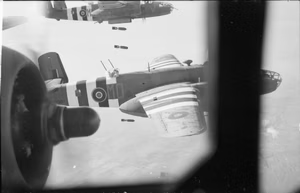
Royal Air Force- 2nd Tactical Air Force, 1943-1945 North American Mitchell Mk IIs of No. 226 Squadron RAF based at Hartford Bridge, Hampshire, dropping 500-lb MC bombs over the Foret de Grimbosq south of Caen, in the evening of 12 June 1944. This operation was the biggest daylight raid mounted by No. 2 Group since 6 June, in which 90 aircraft bombed the 21st Panzer Division which was dispersed in the forest.
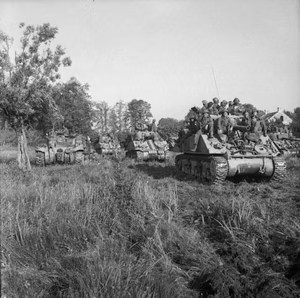
The British Army in Normandy 1944 Sherman tanks carrying infantry wait to advance at the start of Operation 'Goodwood', 18 July 1944.
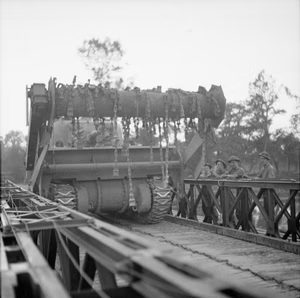
The British Army in Normandy 1944 A Sherman Crab flail tank crosses a Bailey bridge over the Orne, as it moves up to the start line for Operation 'Goodwood', 18 July 1944.
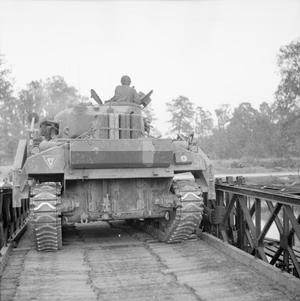
The British Army in Normandy 1944 A Sherman Crab flail tank crosses a Bailey bridge over the Orne, as it moves up to the start line for Operation 'Goodwood', 18 July 1944.
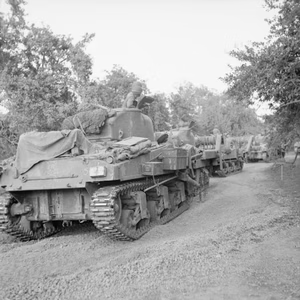
The British Army in Normandy 1944 Sherman Crab flail tanks wait to advance at the start of Operation 'Goodwood', 18 July 1944.
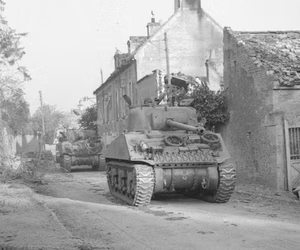
Sherman Firefly passes through Ecosville during Operation Goodwood, 18 July 1944
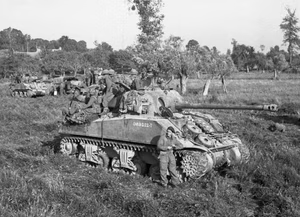
Sherman Firefly with its squadron await the order to move forward at the start of Operation Goodwood, 18 July 1944.
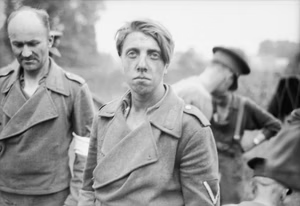
The British Army in North-west Europe 1944-45 German prisoners taken during Operation 'Goodwood', 19 July 1944.
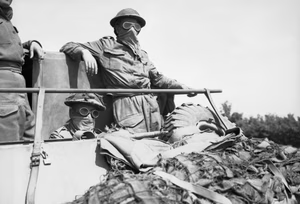
Guardsmen of 3rd Irish Guards in a Loyd carrier, wrapped up against the clouds of dust, during Operation 'Goodwood', Normandy, 18 July 1944. Guardsmen of 3rd Irish Guards in a Loyd carrier, wrapped up against the clouds of dust, during Operation 'Goodwood', 18 July 1944.
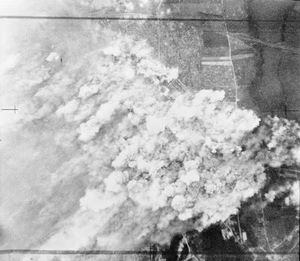
Royal Air Force Bomber Command, 1942-1945. Vertical aerial photograph showing smoke from exploding bombs smothering the Colombelles steelworks, east of Caen, France during the attack by aircraft of Bomber Command in support of the Second Army's armoured advance in the Normandy battle area, (Operation GOODWOOD).
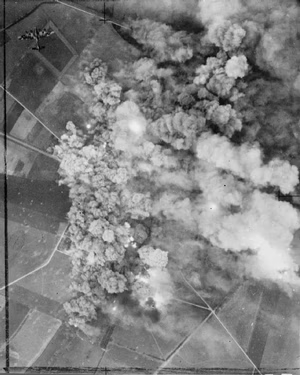
Royal Air Force Bomber Command, 1942-1945. An Avro Lancaster leaves the target area (top left), as smoke from exploding bombs smothers the village of Villers-Bocage, south-west of Caen, France. 942 aircraft of Bomber Command were despatched to bomb German-held positions, in support of the Second Army attack in the Normandy battle area (Operation GOODWOOD), on the morning of 18 July 1944.
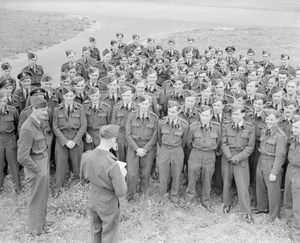
Royal Air Force 1939-1945- Bomber Command Watched by the CO, Wing Commander D A Gardner (left), aircrew of No 166 Squadron at Kirmington, Lincolnshire, gather on 20 July 1944 to hear the Adjutant, Flight Lieutenant F C Tigh, read out a congratulatory message from Field Marshal Montgomery, thanking the bomber crews for their efforts supporting the British Second Army's armoured offensive in Normandy, Operation 'Goodwood'.
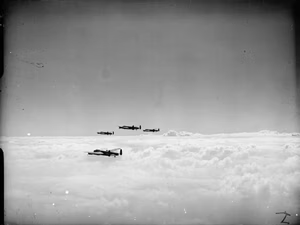
Royal Air Force Bomber Command, 1942-1945. Four Avro Lancasters of No. 514 Squadron RAF flying over complete cloud cover during a daylight attack on fortified villages east of Caen, in support of the Second Army's armoured offensive in the Normandy battle area (Operation GOODWOOD).
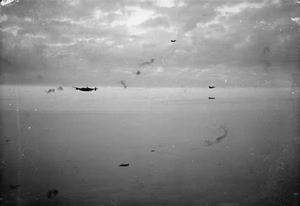
Royal Air Force Bomber Command, 1942-1945. Avro Lancasters and Handley Page Halifaxes fly through anti-aircraft fire to bomb fortified villages east of Caen, France in a dawn attack by 942 aircraft, before the commencement of the Second Army's armoured attack in the Normandy battle area (Operation GOODWOOD).
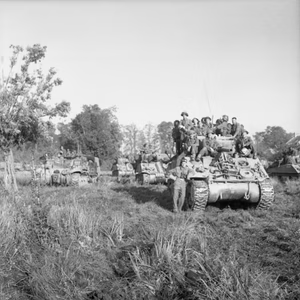
Sherman tanks carrying infantry wait to advance at the start of Operation 'Goodwood', Normandy, 18 July 1944. Sherman tanks carrying infantry wait to advance at the start of Operation 'Goodwood', 18 July 1944.