
Bastogne — Siege of the 101st Airborne
Bastogne, BE
Bastogne became the most famous location of the **Battle of the Bulge** — the name synonymous with American defiance during Germany's last major offensive in the West. When **Operation Wacht am Rhein** began on December 16, 1944, seven German divisions converged on the Ardennes, seeking to break through and capture the vital crossroads town of Bastogne, which controlled the road network the panzers needed to reach the Meuse. The **101st Airborne Division** ('Screaming Eagles'), along with elements of several armoured and infantry units, were rushed to Bastogne and encircled by December 21. German General von Lüttwitz demanded surrender; Brigadier General **Anthony McAuliffe** replied with the famous single word: **"NUTS!"** The division held the perimeter through Christmas 1944, enduring artillery bombardment, infantry assaults, and supply shortages. On December 26, elements of **Patton's 4th Armoured Division** broke through from the south, ending the siege. The battle for Bastogne continued into January 1945 as Allied forces consolidated the Ardennes salient — but the town's ability to hold had been decisive in slowing the German advance and buying time for the Allied response.
Photographs (19)
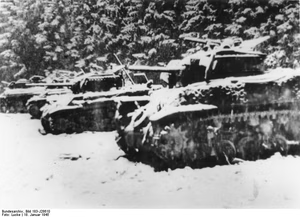
For documentary purposes the German Federal Archive often retained the original image captions , which may be erroneous, biased, obsolete or politically extreme . Von unseren Panzerjägrn zusammengeschossen. An der belgischen-luxemburgischen Grenze wurden eine US-amerikanische Panzerabteilung in der Flanke von schweren deutschen Panzerjägern gefaßt und zusammengeschossen. Bewegungsunfähig steht hier eine Gruppe der abgeschossenen USA-Panzer. PK-Aufnahme: Kriegsberichter Lucke 18.1.1945 RPK III/280
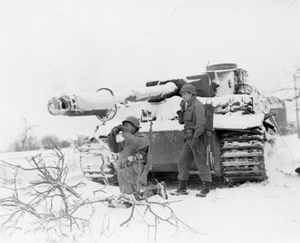
How 81mm mortar observers work, is demonstrated by SSGT Glenn K. Keller, Fairfield IA., left, and PFC Virgil Williams, Pitcairn PA., using binoculars and phone, near Oberwampach, Luxembourg. Both Men are with the 90th Infantry Division. Co. D, 358th Inf. Regiment, 90th Infantry Division, Jan 25 1945.
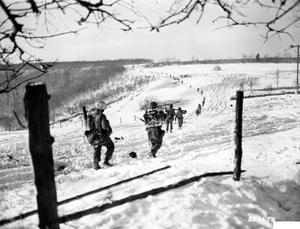
24 January, 1945. 1st Battalion, 10th Infantry Regiment, 5th Infantry Division. Photographer: Dougall, 166th Signal Photo Co. Photo Source: U.S. National Archives. Digitized by Signal Corps Archive.
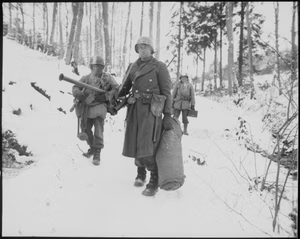
After holding a woodland position all night near Wiltz, Luxembourg, against German counter attack, three men of B Company, 101st Engineers, emerge for a rest. NARA 531349.gif
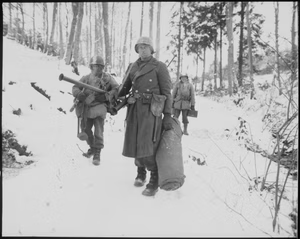
General notes: Use War and Conflict Number 1078 when ordering a reproduction or requesting information about this image.
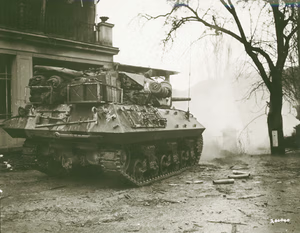
An M10 tank destroyer from the 803rd Tank Destroyer Battalion firing on a German pillbox on the other side of the Sauer River near Echternach, Luxembourg, supporting an advance by the 5th Infantry Division's 11th Infantry Regiment. Signal Corps Photo #200040
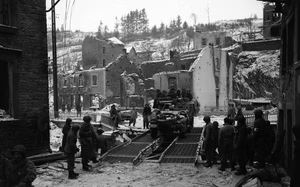
News From Belgium, 1945
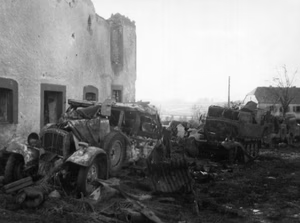
Destroyed German vehicles at Marnach, Luxembourg. The vehicles were destroyed by air attacks during the German withdrawal across the Our river in Northern Luxembourg, 22-25 January 1945.
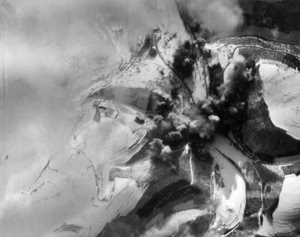
The bridge across the river Our at Dasburg on the border of Luxembourg and Germany is bombed by Martin B-26 Marauder s of the 387th and 394th Bombardment Groups, shortly after 0900 hrs, 22 January 1945. German troops were retreating from Luxembourg on the Clervaux-Marnach-Dasburg road.
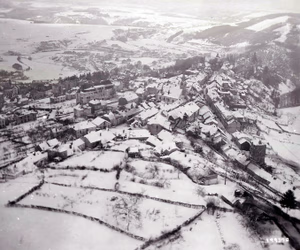
An aerial view of the town of Wiltz, Luxembourg, which the U.S. 3rd Army's 26th InfantryDivision and the 6th Cavalry Division captured on the 22 January 1945.
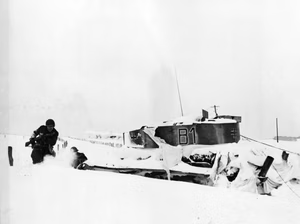
Abandoned German Panzerkampfwagen IV Ausführung J near Weiswampach, Luxembourg, 2 February 1945.
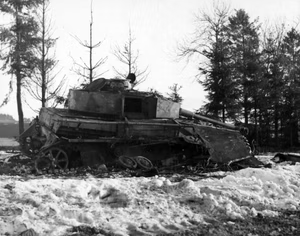
A destroyed German Panzer IV in Luxembourg, circa in February 1945.
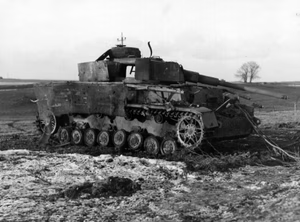
A destroyed German Panzer IV in Luxembourg, in 1945.
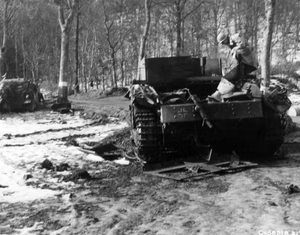
A destroyed German Bergepanzer III recovery vehicle and another tank (Sturmgeschütz II?) near Hosingen, Luxembourg, in February 1945.
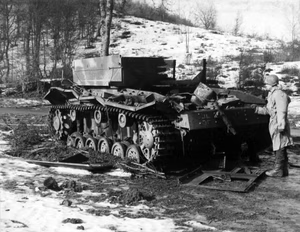
A destroyed German Bergepanzer III recovery vehicle near Hosingen, Luxembourg, in February 1945.
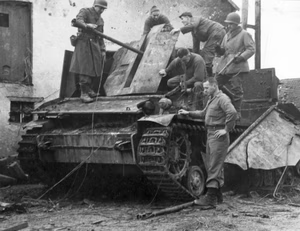
A captured German Flakpanzerkampfwagen IV (3,7cm Flak 43) (Sd.Kfz. 161/3) „Möbelwagen“ at Hosingen, Luxembourg, in February 1945.
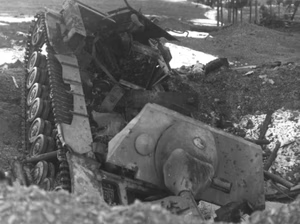
A destroyed German Jagdpanzer IV near Marnach, Luxembourg, in January 1945. The description claims that the tank was destroyed by fighter-bombers of the U.S. XIX Tactical Air Command during the German withdrawal across the Our river to Dasburg, Germany, 22-25 January 1945.
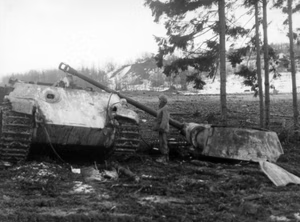
A destroyed German Panzer V Panther tank near Marnach, Luxembourg, 5 km west of Dasburg, Germany, 22-25 January 1945.
Bastogne — Siege of the 101st Airborne