Tracefront
← Map
BattlefieldApproximate location

Falaise Gap — Chambois, August 1944

Orne, FR

0 artifacts13 photographsSubmitted by Admin

Photographs (13)

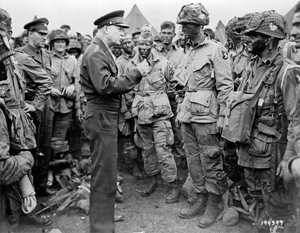
General Dwight D. Eisenhower addresses American paratroopers prior to D-Day. "Gen. Dwight D. Eisenhower gives the order of the Day. 'Full victory-nothing less' to paratroopers in England, just before they board their airplanes to participate in the first assault in the invasion of the continent of Europe." Eisenhower is meeting with US Co. E, 502nd Parachute Infantry Regiment (Strike) of the 101st Airborne Division, photo taken at Greenham Common Airfield in England about 8:30 p.m. on June 5, 1944. The General was talking about fly fishing with his men as he always did before a stressful operation (Eisenhower speaks with Hartsock). Memoir by Lt Wallace C. Strobel about this photo (seen wearing the number 23 around his neck): https://web.archive.org/web/20201123025151/http://www.historyaddict.com/Ike502nd.html
General Dwight D. Eisenhower addresses American paratroopers prior to D-Day. "Gen. Dwight D. Eisenhower gives the order of the Day. 'Full victory-nothing less' to paratroopers in England, just before they board their airplanes to participate in the first assault in the invasion of the continent of Europe." Eisenhower is meeting with US Co. E, 502nd Parachute Infantry Regiment (Strike) of the 101st Airborne Division, photo taken at Greenham Common Airfield in England about 8:30 p.m. on June 5, 1944. The General was talking about fly fishing with his men as he always did before a stressful operation (Eisenhower speaks with Hartsock). Memoir by Lt Wallace C. Strobel about this photo (seen wearing the number 23 around his neck): https://web.archive.org/web/20201123025151/http://www.historyaddict.com/Ike502nd.html

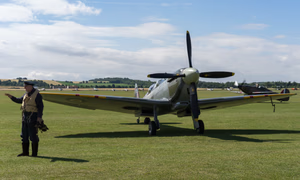
Two seat dual controlled Spitfire T.IX Rolls Royce Merlin 25, 1800hp. Colour Scheme: 485 Squadron RAF Built at Castle Bromwich as a single seat low level LF Mark IX fighter, The Grace Spitfire served in the front line of battle throughout the last twelve months of WWII. ML407 is currently in the colour scheme as she was when delivered on 29 April 1944 by a famous lady A.T.A. pilot, Jackie Moggridge, to 485 New Zealand Squadron at ALG Selsey to Flying Officer Johnnie Houlton DFC, with Squadron letters OU and Johnnie’s personal insignia letter V (for Vicki his wife to be). In 2014 the Grace Spitfire celebrated the 70th Anniversary on 29 April 1944, of D-Day when on 6 June 1944 Johnnie Houlton flying his Spitfire OU-V was accredited with shooting down the first enemy aircraft (Junkers 88) over the Normandy beach head just south of Omaha Beach. ML407 did a total of 176 operational sorties, predominantly ground attack, amassing over 320 combat hours whilst in the 2nd Tactical Air Force (TAF) going from 485 New Zealand Squadron in December 1944 to 341 Free French, 308 Polish, 349 Belgian, 345 Free French, 332 Norwegian Squadrons, returning to 485 New Zealand Squadron at the end of the War. Miraculously, ML407 did not suffer any major structural damage during this time. In 1951 Vickers Armstrong at Southampton was commissioned by the Irish Air Corps to convert 20 Spitfires to the trainer configuration. ML407 was one of these, serving with the Irish Army Air Corps as IAC162 until 1960 with a total time of 763 hours flown for the IAC. In 1968 ML407 was sold on, finally ending up in Scotland, and went into storage. <a href=" http://ultimatewarbirdflights.com/flights/supermarine-spitfire-t-ix-ml407/ " rel="nofollow">ultimatewarbirdflights.com/flights/supermarine-spitfire-t...</a>
Two seat dual controlled Spitfire T.IX Rolls Royce Merlin 25, 1800hp. Colour Scheme: 485 Squadron RAF Built at Castle Bromwich as a single seat low level LF Mark IX fighter, The Grace Spitfire served in the front line of battle throughout the last twelve months of WWII. ML407 is currently in the colour scheme as she was when delivered on 29 April 1944 by a famous lady A.T.A. pilot, Jackie Moggridge, to 485 New Zealand Squadron at ALG Selsey to Flying Officer Johnnie Houlton DFC, with Squadron letters OU and Johnnie’s personal insignia letter V (for Vicki his wife to be). In 2014 the Grace Spitfire celebrated the 70th Anniversary on 29 April 1944, of D-Day when on 6 June 1944 Johnnie Houlton flying his Spitfire OU-V was accredited with shooting down the first enemy aircraft (Junkers 88) over the Normandy beach head just south of Omaha Beach. ML407 did a total of 176 operational sorties, predominantly ground attack, amassing over 320 combat hours whilst in the 2nd Tactical Air Force (TAF) going from 485 New Zealand Squadron in December 1944 to 341 Free French, 308 Polish, 349 Belgian, 345 Free French, 332 Norwegian Squadrons, returning to 485 New Zealand Squadron at the end of the War. Miraculously, ML407 did not suffer any major structural damage during this time. In 1951 Vickers Armstrong at Southampton was commissioned by the Irish Air Corps to convert 20 Spitfires to the trainer configuration. ML407 was one of these, serving with the Irish Army Air Corps as IAC162 until 1960 with a total time of 763 hours flown for the IAC. In 1968 ML407 was sold on, finally ending up in Scotland, and went into storage. <a href=" http://ultimatewarbirdflights.com/flights/supermarine-spitfire-t-ix-ml407/ " rel="nofollow">ultimatewarbirdflights.com/flights/supermarine-spitfire-t...</a>

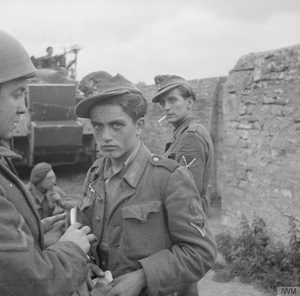
The British Army in the Normandy Campaign, 1944 German prisoners being searched by British troops near St. Gabriel, 7 June 1944. Both men claimed to be Polish, and had Polish army badges stuck in the fronts of their field caps.
The British Army in the Normandy Campaign, 1944 German prisoners being searched by British troops near St. Gabriel, 7 June 1944. Both men claimed to be Polish, and had Polish army badges stuck in the fronts of their field caps.

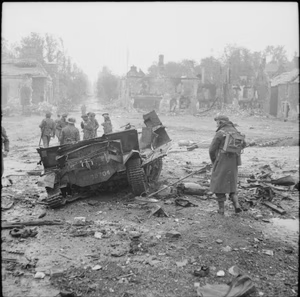
The British Army in the Normandy Campaign 1944 The remains of a universal carrier blown up by a mine in Tilly-sur-Seulles, 19 June 1944.
The British Army in the Normandy Campaign 1944 The remains of a universal carrier blown up by a mine in Tilly-sur-Seulles, 19 June 1944.

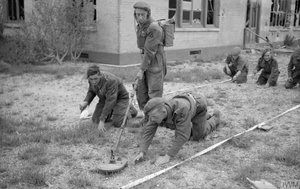
The British Army in Normandy 1944 Sappers clearing the last mines from the beach front of a former French luxury hotel, now in use as a rest club for troops of 3rd Division, 15 July 1944.
The British Army in Normandy 1944 Sappers clearing the last mines from the beach front of a former French luxury hotel, now in use as a rest club for troops of 3rd Division, 15 July 1944.

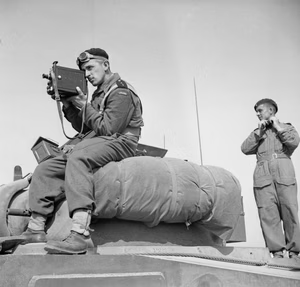
The Polish Army in the Normandy Campaign, 1944 Cameramen in uniform: 2nd Lieutenant Jerzy Januszajtis, a Polish Army Film Unit cameraman, films from the top of a Sherman tank of the 1st Polish Armoured Division tank during Operation 'Totalise', south of Caen, Normandy on 8 August 1944. He is using a De Vry camera fitted with a sling.
The Polish Army in the Normandy Campaign, 1944 Cameramen in uniform: 2nd Lieutenant Jerzy Januszajtis, a Polish Army Film Unit cameraman, films from the top of a Sherman tank of the 1st Polish Armoured Division tank during Operation 'Totalise', south of Caen, Normandy on 8 August 1944. He is using a De Vry camera fitted with a sling.

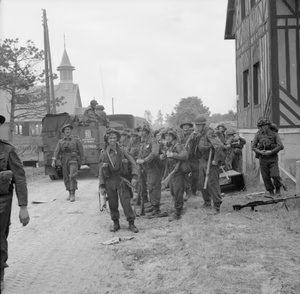
The British Army in Normandy 1944 Men of 2nd Royal Ulster Rifles pause during the move inland from Sword Beach, 6 June 1944.
The British Army in Normandy 1944 Men of 2nd Royal Ulster Rifles pause during the move inland from Sword Beach, 6 June 1944.

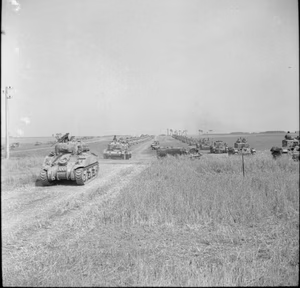
The Polish Army in the Normandy Campaign, 1944 Sherman and Cromwell tanks of the 1st Polish Armoured Division on the move at the start of Operation 'Totalise'.
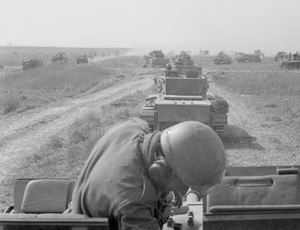
The Polish Army in the Normandy Campaign, 1944 Sherman and Cromwell tanks of the 1st Polish Armoured Division on the move at the start of Operation 'Totalise'.

The Polish Army in the Normandy Campaign, 1944 Column of Cromwell tanks of the 10th Mounted Rifles Regiment (1st Polish Armoured Division) moving towards enemy positions during the Battle of Falaise Pocket.
The Polish Army in the Normandy Campaign, 1944 Column of Cromwell tanks of the 10th Mounted Rifles Regiment (1st Polish Armoured Division) moving towards enemy positions during the Battle of Falaise Pocket.

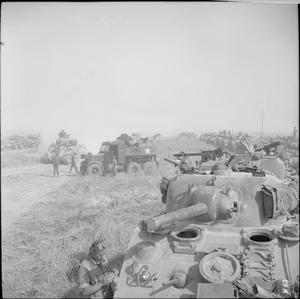
The Polish Army in the Normandy Campaign, 1944 Sherman tanks of the 1st Polish Armoured Division in line at the start of Operation 'Totalise'.
The Polish Army in the Normandy Campaign, 1944 Sherman tanks of the 1st Polish Armoured Division in line at the start of Operation 'Totalise'.

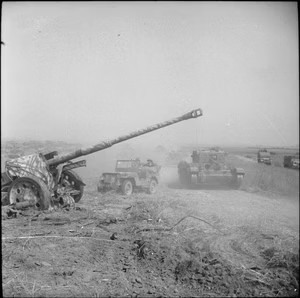
The Polish Army in the Normandy Campaign, 1944 A Cromwell tank of the 1st Polish Armoured Division and jeep pass an abandoned German 88mm anti-tank gun during Operation 'Totalise'.
The Polish Army in the Normandy Campaign, 1944 A Cromwell tank of the 1st Polish Armoured Division and jeep pass an abandoned German 88mm anti-tank gun during Operation 'Totalise'.

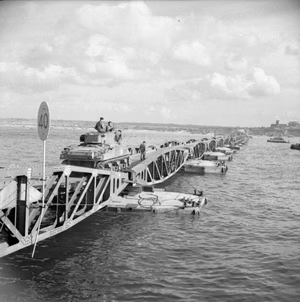
The Polish Army in Normandy 1944 Sherman tank of the 1st Polish Armoured Division commencing its journey to shore along Floating Bridge at Arromanches.
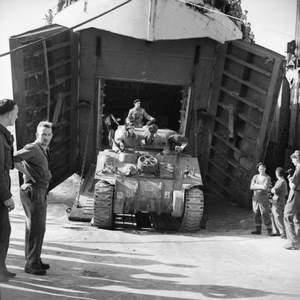
The Polish Army in Normandy 1944 Sherman tank of the 1st Polish Armoured Division commencing its journey to shore along Floating Bridge at Arromanches.

The Polish Army in Normandy 1944 Sherman tank of the 1st Polish Armoured Division disembarking from an LST onto the Mulberry artificial harbour at Arromanches.

The Polish Army in Normandy 1944 Sherman tank of the 1st Polish Armoured Division disembarking from an LST onto the Mulberry artificial harbour at Arromanches.